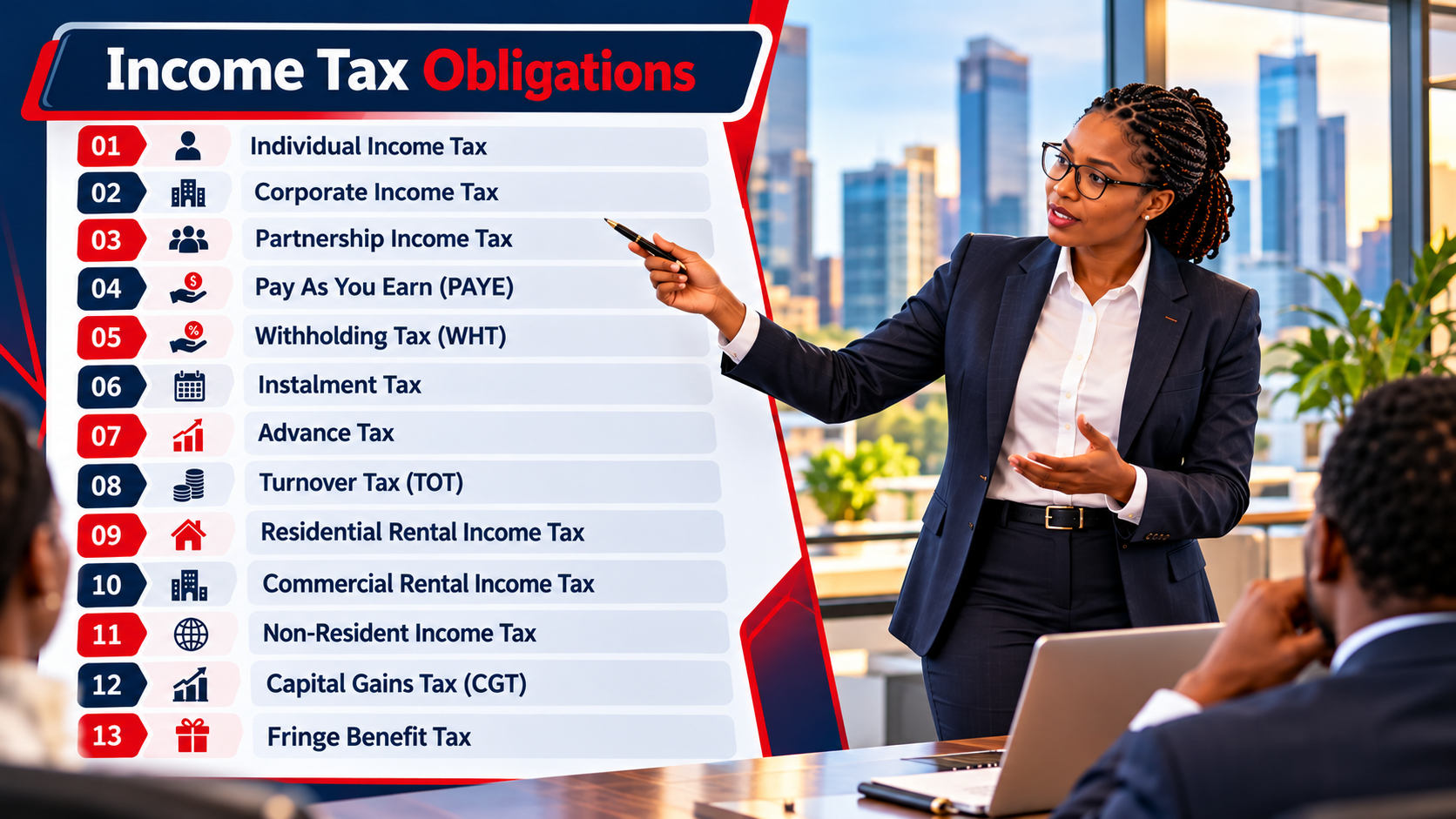
Income Tax Obligations
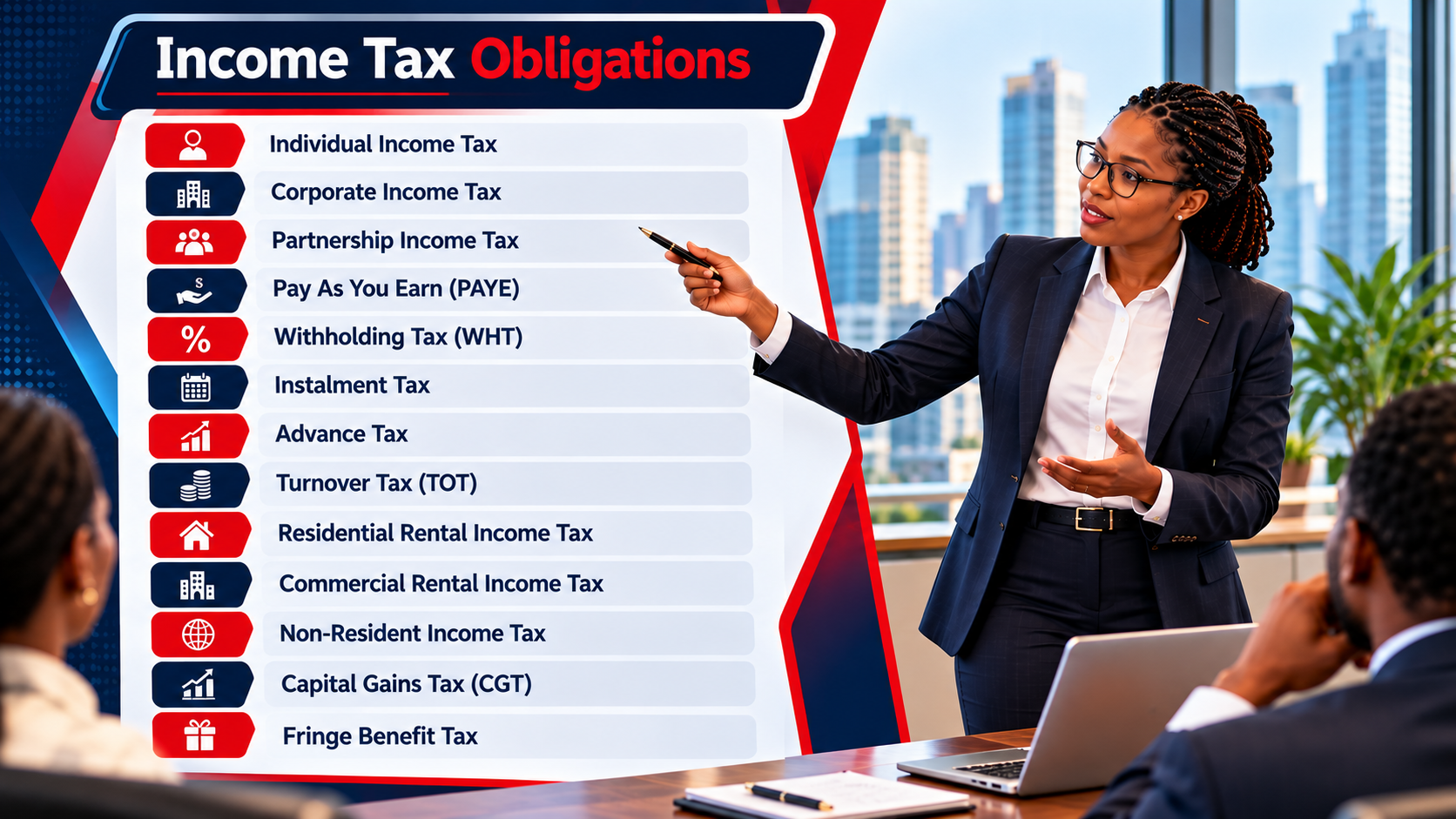
Income tax is charged on the profit a business makes: what it earns minus the genuine costs of earning it. A company pays corporation tax at 30% of its taxable profit, while a sole proprietor or partner is taxed at individual rates of up to 35%. Income tax is not a once-a-year event. Most businesses pay instalment tax during the year based on expected profit, then file an annual return, due by 30 June the following year for a company with a December year-end. Every figure in that return must be supported, and KRA now checks it against eTIMS, withholding tax, and customs data.
In practice: A furniture workshop in Nairobi earns KES 20 million and spends KES 14 million, leaving KES 6 million in profit and KES 1.8 million in tax. But KES 2 million of its timber and hardware purchases came from suppliers who gave ordinary receipts. When KRA validates the return, those purchases are disallowed, profit rises to KES 8 million and tax rises to KES 2.4 million. The owner also skipped instalment tax, so penalties and interest follow. In this programme, participants learn how taxable profit is calculated, which expenses are allowable and how to support them, how instalment tax works, and how to prepare and file an accurate annual return on iTax, so the workshop pays tax on its real profit and nothing more.
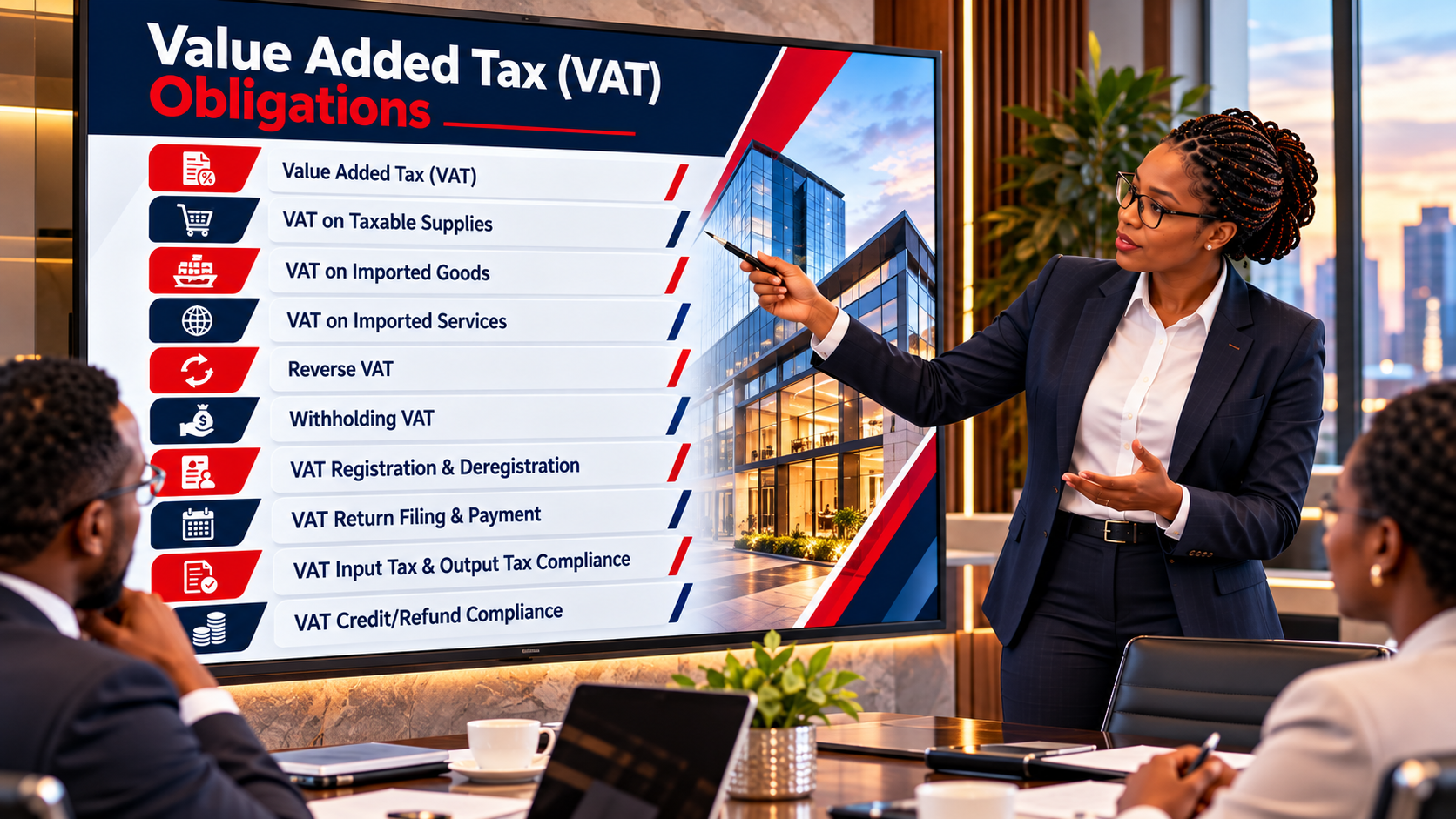
Value Added Tax (VAT) Obligations
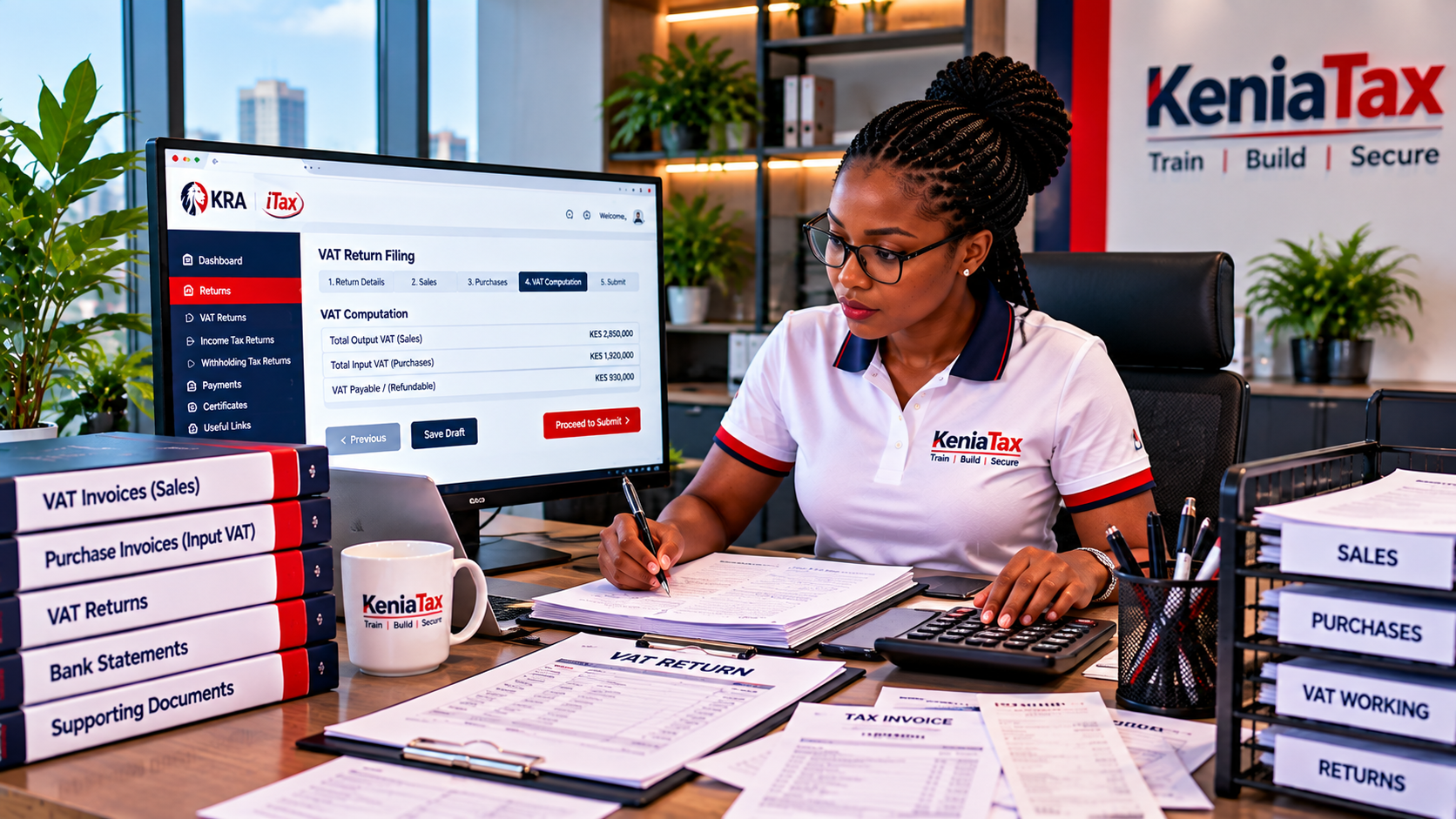
VAT is a tax on consumption that businesses collect for the government. A VAT-registered business adds VAT, usually at 16%, to its sales, claims back the VAT it pays on its business purchases, and pays the difference to KRA every month by the 20th. Registration is required once taxable sales reach KES 5 million in any twelve months. Some goods and services are taxed at 16%, some at zero and some are exempt, and getting these categories right is one of the biggest compliance challenges in Kenya.
In practice: A distributor sells goods worth KES 1 million in a month and charges KES 160,000 in VAT. It paid KES 96,000 in VAT on its stock, so it should pay KRA only KES 64,000. But because its suppliers’ invoices were not valid eTIMS invoices carrying its PIN, it cannot claim the KES 96,000 and must pay the full KES 160,000. Some of its older invoices also fall outside the six-month window for claiming input VAT. In this programme, participants learn when to register, how to apply the right rates, how to issue and verify eTIMS invoices, how to claim every shilling of input VAT on time, how withholding VAT works and how to file monthly returns without penalties.
Employment & Payroll Tax Obligations
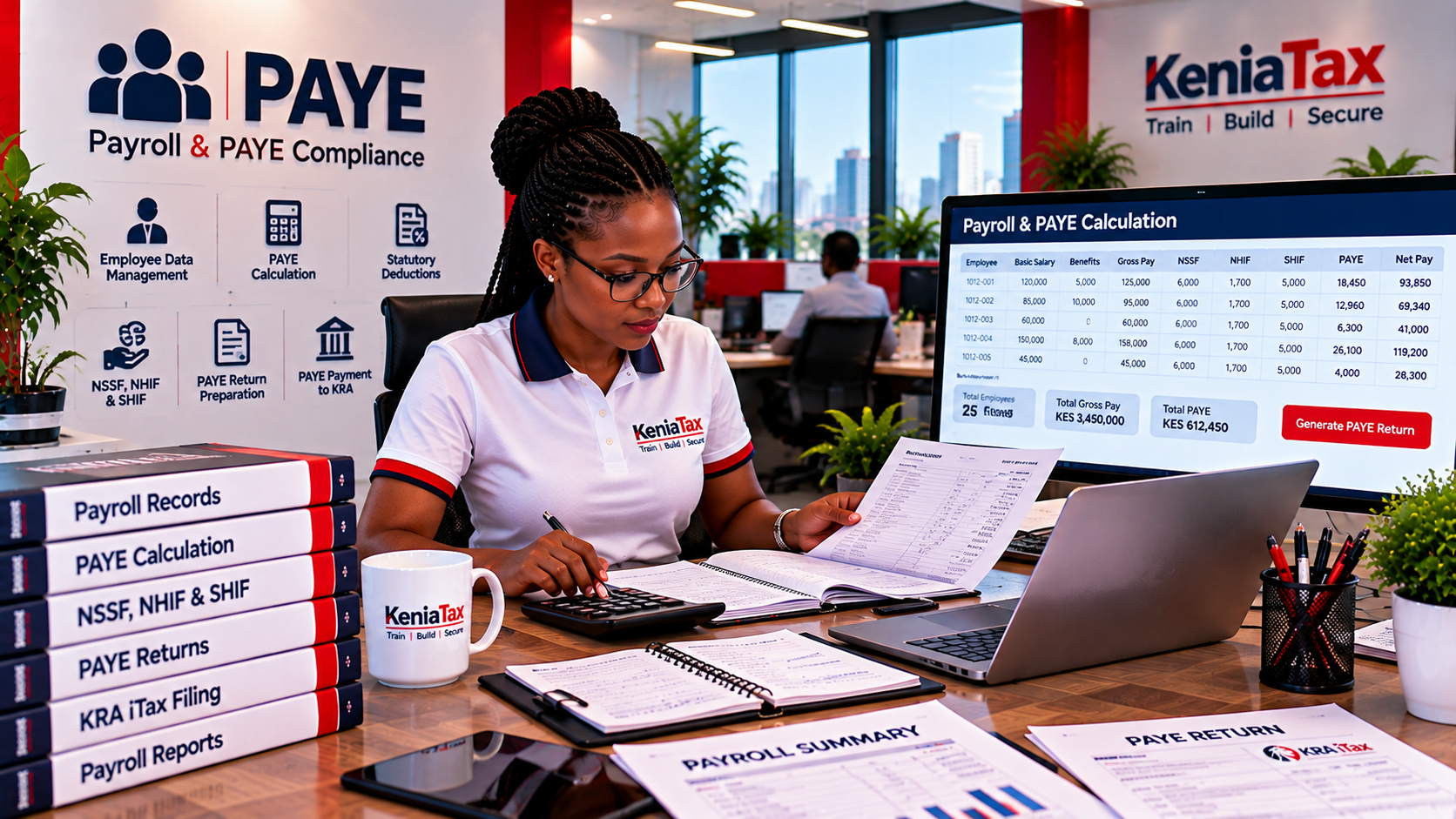
Every employer is responsible for deducting tax and statutory contributions from its employees’ pay and sending them to the right place on time. That includes PAYE on salaries and taxable benefits, generally due by the 9th of the following month, as well as the Affordable Housing Levy at 1.5% from both employer and employee, SHIF contributions at 2.75% of gross pay, and NSSF contributions. Allowances, per diems, housing, cars, staff loans and bonuses each have their own tax treatment, and the employer, not the employee, is liable for any tax that should have been deducted but was not.
In practice: A security company with 200 guards pays each guard a monthly “transport allowance” and treats it as tax-free. It also pays its directors’ bonuses directly from the bank account, outside the payroll. During an audit, KRA finds no records linking the allowances to actual travel and treats them as salary, then compares the staff costs in the accounts with the pay declared for PAYE and finds the bonuses missing. The company faces PAYE, levies, penalties and interest across several years. In this programme, participants learn how to calculate PAYE and statutory deductions correctly, which allowances and benefits are taxable, how to document reimbursements and per diems, how to handle directors’ pay and bonuses, and how to file and pay on time so the payroll is fully compliant.
Withholding Tax Obligations
Withholding tax requires a business to keep back part of certain payments and send it to KRA on behalf of the person being paid. It applies to payments such as professional, consultancy, management and contractual fees, commercial rent, interest, dividends, royalties and many payments to non-residents. The rate depends on the type of payment and whether the recipient is resident in Kenya. The business must remit the tax promptly through iTax and issue a certificate. Withholding tax also works in reverse: when your clients withhold tax from your invoices, those certificates are credits against your own income tax.
In practice: A real estate developer pays an architect KES 2 million and a building contractor KES 30 million but pays both in full without withholding anything. Two years later, KRA’s audit holds the developer liable for the tax it should have withheld, plus penalties and interest, and recovering that money from the architect and contractor proves impossible. Meanwhile, the developer’s own clients withheld tax on its consultancy income, but nobody tracked the certificates, so those credits were never claimed. In this programme, participants learn which payments require withholding and at what rates, how to remit and issue certificates on iTax, how withholding VAT works, and how to track and claim every certificate issued to them.
Rental Income Tax Obligations
Anyone who earns rent from property must pay tax on it. Residential landlords whose rent falls between KES 288,000 and KES 15 million a year pay monthly rental income tax at 7.5% of the gross rent collected, by the 20th of the following month, with no deductions for expenses. Commercial landlords and larger investors declare their net rental profit in the annual income tax return, deducting genuine costs such as repairs, management fees and loan interest. KRA uses land records, utility data, bank records and tenants’ withholding certificates to identify rental income.
In practice: A retired civil servant owns two apartment blocks managed by an agent. Tenants pay KES 400,000 a month in total, but the agent deducts commission and repairs and remits KES 320,000, which is the figure the landlord declares. She also lets a shop to a bank that withholds tax on the rent, but she never declared that property at all. When KRA matches the bank’s certificates and the agent’s records, it raises an assessment covering several years. In this programme, participants learn which rental regime applies to each property, how to declare gross rent correctly, how to treat agents, deposits, arrears and vacancies, how to handle tenant withholding and VAT on commercial rent, and how to correct past non-compliance before KRA finds it.
Turnover Tax Obligations
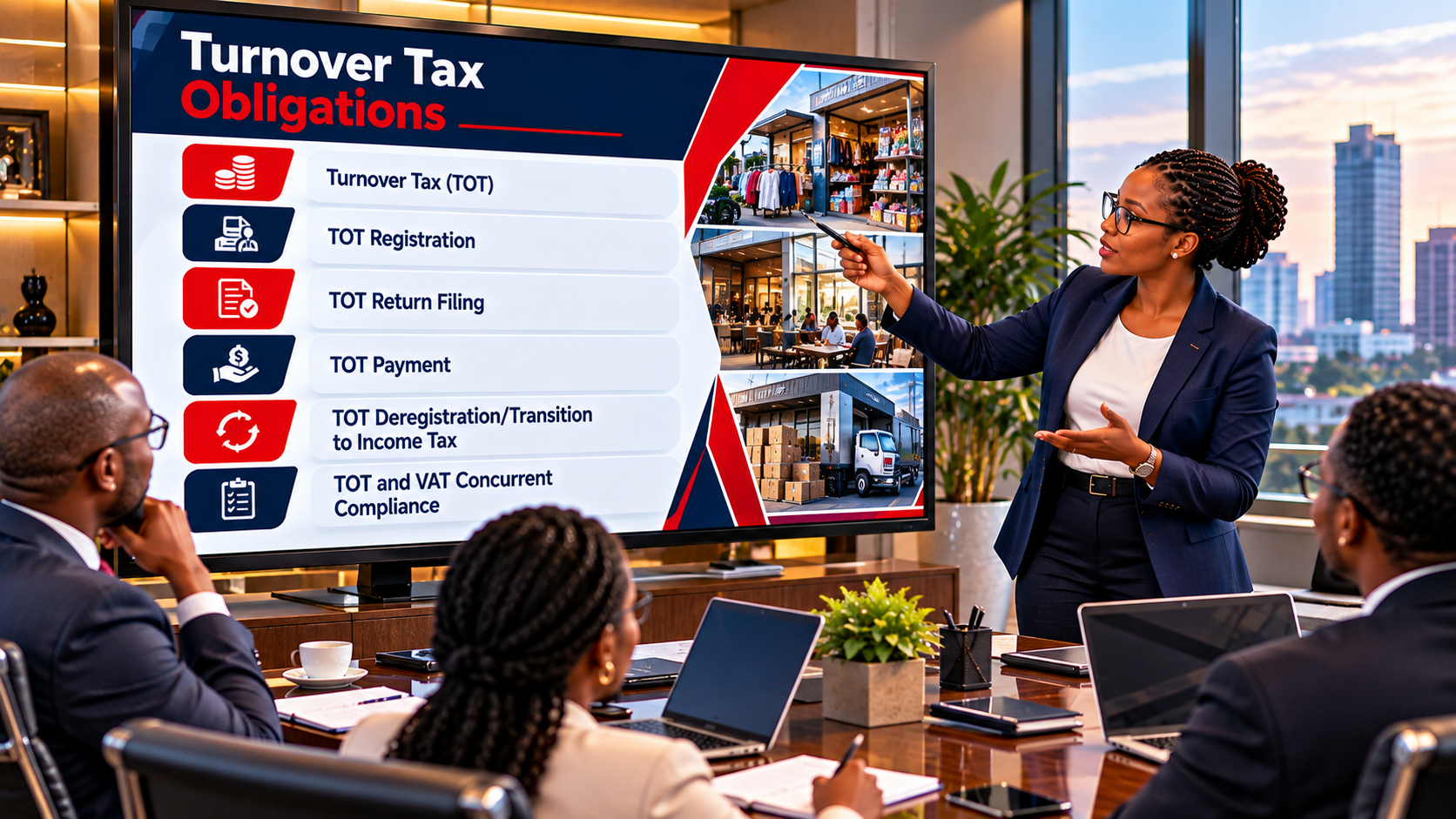
Turnover tax is a simplified tax for small businesses with annual sales between KES 1 million and KES 25 million. Instead of calculating profit, the business pays 1.5% of its gross sales every month by the 20th. It is easy to understand and requires fewer records, but it is charged on sales, not profit, so it is payable even in months when the business makes a loss. Some types of income, such as rent and professional fees, are excluded and must be taxed separately.
In practice: A cosmetics shop in Kisumu sells about KES 1.2 million worth of products a month, but the owner has never registered for any tax because she assumed small businesses were exempt. When she applies for a supply contract with a county government, she is asked for a Tax Compliance Certificate and discovers that KRA can assess her for every month she should have filed, with penalties and interest. In this programme, participants learn whether their business qualifies for turnover tax, how to register, calculate and file monthly, which income falls outside the regime, how to keep simple records that stand up to KRA review and when to move to the regular income tax system as the business grows.
Capital Gains Tax Obligations
Capital gains tax applies when land, buildings or shares in a private company are sold or transferred for more than they cost. The gain, which is the sale price minus the full cost of the asset including legal fees, stamp duty and the cost of genuine improvements, is taxed at 15%. For property, the tax must generally be paid before the transfer is registered. Certain transfers are exempt, such as some transfers between spouses and close family and shares listed on the Nairobi Securities Exchange.
In practice: A family business bought a plot in 2014 for KES 4 million and spent KES 1.5 million on legal fees, fencing and a borehole. It sells the plot in 2026 for KES 15 million. If it can prove all its costs, the gain is KES 9.5 million and the tax is KES 1.425 million. Because it kept no receipts for the improvements, it can only prove the purchase price, the gain becomes KES 11 million and the tax rises to KES 1.65 million. In this programme, participants learn when a transfer is taxable, how to calculate the gain, which costs to include, which exemptions may apply and how to file and pay on time so the transaction closes smoothly.
Excise Duty Obligations
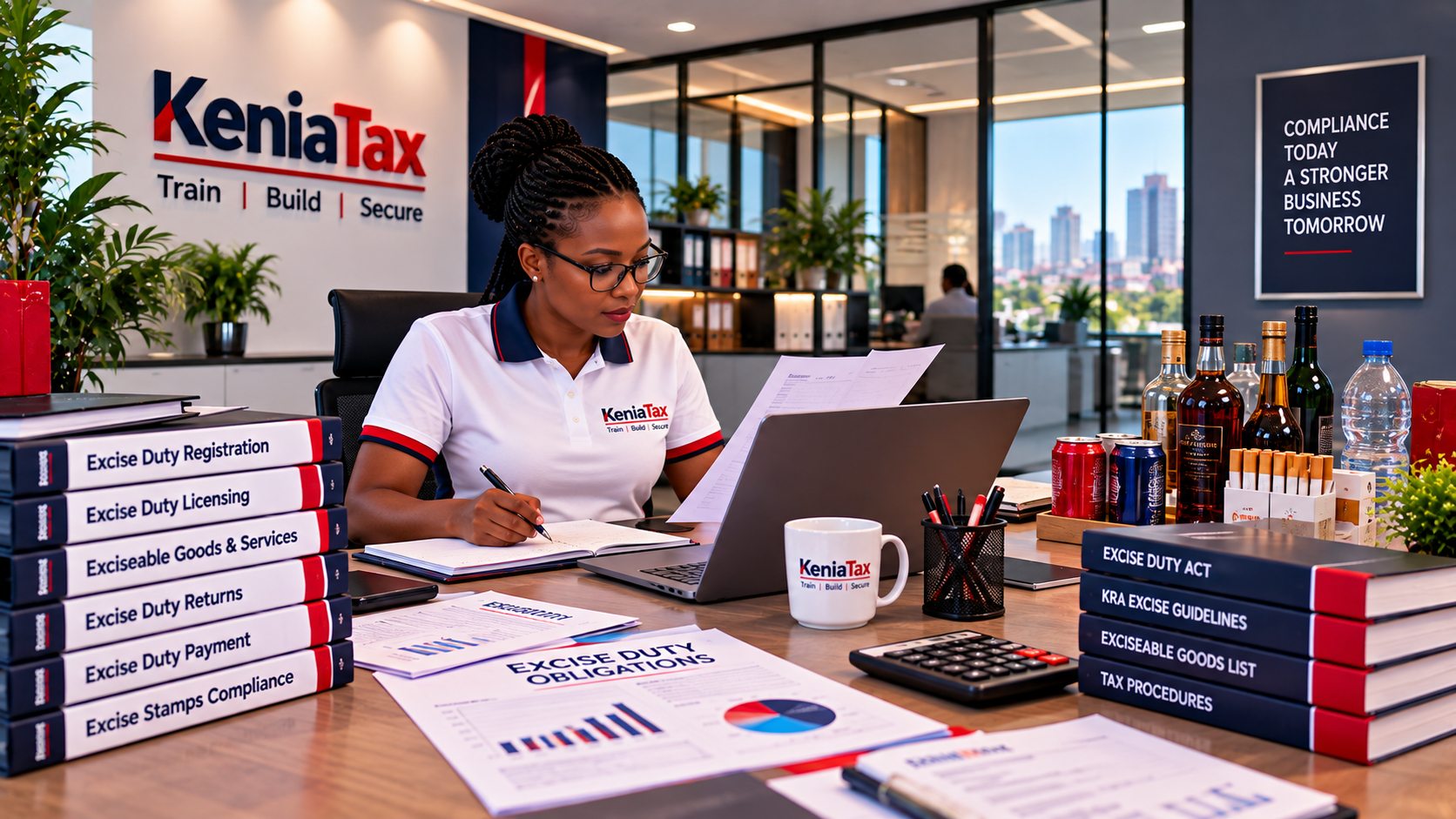
Excise duty is an additional tax on specific goods and services, charged on top of VAT. It applies to products such as alcoholic drinks, cigarettes, bottled water, juices, soft drinks, sugar confectionery, fuel and motor vehicles, and to services such as mobile money transfers, telephone and internet data, financial service fees and betting. Some items are taxed as a percentage of value and others at a fixed amount per litre, kilogram or unit. Manufacturers and importers of excisable goods generally need an excise licence, many products must carry excise stamps, and returns are filed monthly by the 20th.
In practice: A small company starts producing flavoured bottled water in Nakuru and sells through supermarkets without excise stamps, because it did not know they were required. During a market inspection, KRA seizes its stock, suspends its operations, and raises an assessment for unpaid excise duty with penalties. In this programme, participants learn how to identify excisable goods and services, apply the correct rates, obtain licences and manage excise stamps, file and pay monthly returns and keep up with the rate changes that each Finance Act brings.
Customs & Import/Export Tax Obligations
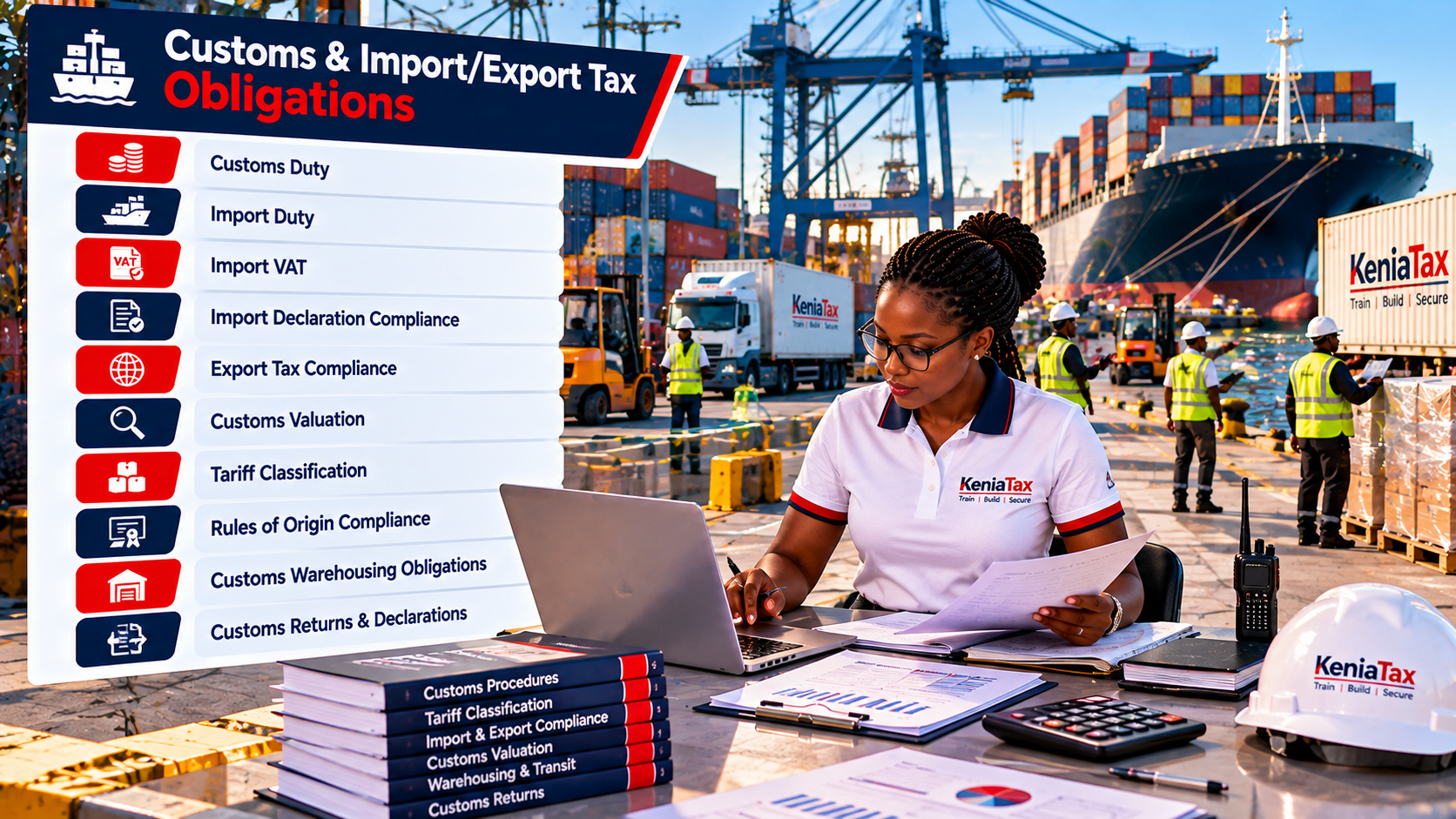
Goods crossing Kenya’s border attract customs obligations. Imported goods are subject to import duty under the East African Community Common External Tariff, VAT on imports, and often excise duty and other charges such as the Import Declaration Fee and the Railway Development Levy. The duty depends on how the goods are classified under their tariff code and on their customs value, which generally includes cost, insurance, and freight. Exports are usually free of these taxes, but only when properly documented.
In practice: An electronics importer has been declaring its goods under a tariff code with 10% duty for three years, when the correct code carries 25%. A post-clearance audit identifies the error across every shipment and raises an assessment for the underpaid duty, the related VAT, penalties and interest, an amount large enough to threaten the business. In this programme, participants learn how goods are classified and valued, which duties and levies apply, how to work effectively with clearing agents, how to document exports for VAT zero-rating, and how to keep records that hold up in a customs audit.
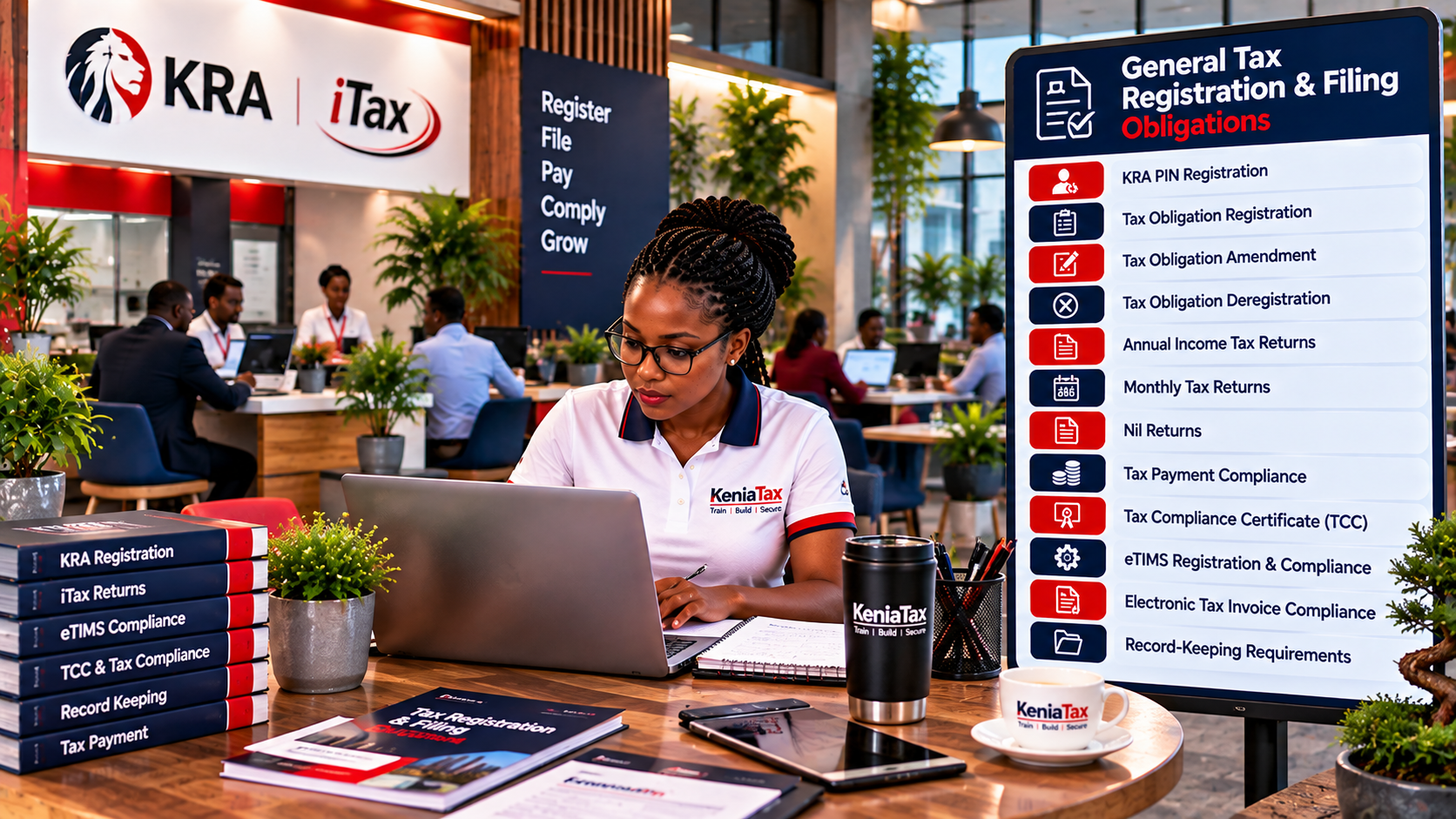
General Tax Registration & Filing Obligations
Every tax journey begins with a KRA PIN. Once registered, a business must be set up on iTax for the taxes that apply to it, onboarded to eTIMS, and must file every return for every obligation on its PIN, even when there is nothing to declare. Individuals with a PIN must file an annual return by 30 June, even with no taxable income. Changes to a business’s address, directors, activities or bank details must be updated, and obligations must be closed properly when a business stops trading.
In practice: A young events company registers for VAT when it starts, expecting fast growth. Sales stay small, so the owner assumes there is nothing to file. A year later, applying for a Tax Compliance Certificate to bid for a corporate contract, she finds twelve missed monthly VAT returns, each carrying a late filing penalty of at least KES 10,000. The certificate is refused, and the contract goes to a competitor. In this programme, participants learn how to register for a PIN and the right tax obligations, set up eTIMS, build a filing calendar for every deadline, file nil returns where required, update or close obligations correctly, and keep the business ready for a Tax Compliance Certificate at all times.