Corporate Tax Planning & Strategy
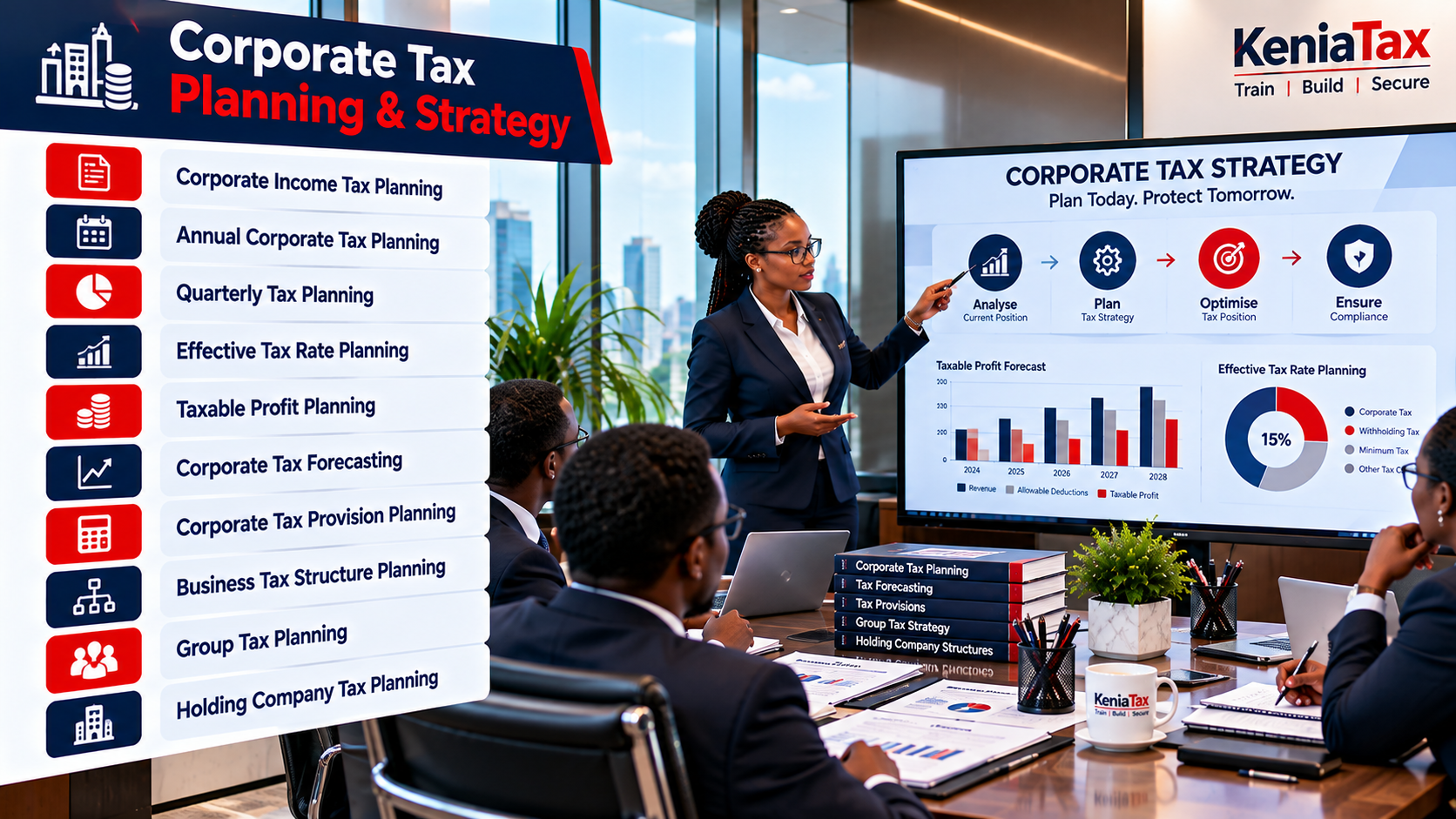
A company pays corporation tax at 30% of its taxable profit, but that profit is shaped throughout the year by management decisions: how the company invests, borrows, pays its people, uses its losses, claims incentives and deals with related companies. Corporate tax planning means looking at these decisions through a tax lens before they are made, and building a board-approved tax strategy that keeps the company’s tax cost low and its risk under control.
In practice: A manufacturer has KES 20 million in tax losses from its early years. Under the Finance Act, 2025, losses can only be carried forward for five years. Nobody tracks when each loss expires, so they lapse just as the company becomes profitable, and it pays full tax on its new profits, losing KES 6 million in tax savings. In this programme, participants learn to plan around the corporate tax cycle, track and use losses before they expire, use allowances and incentives, plan profit extraction and build a tax strategy for the board, so the same company saves its KES 6 million lawfully.
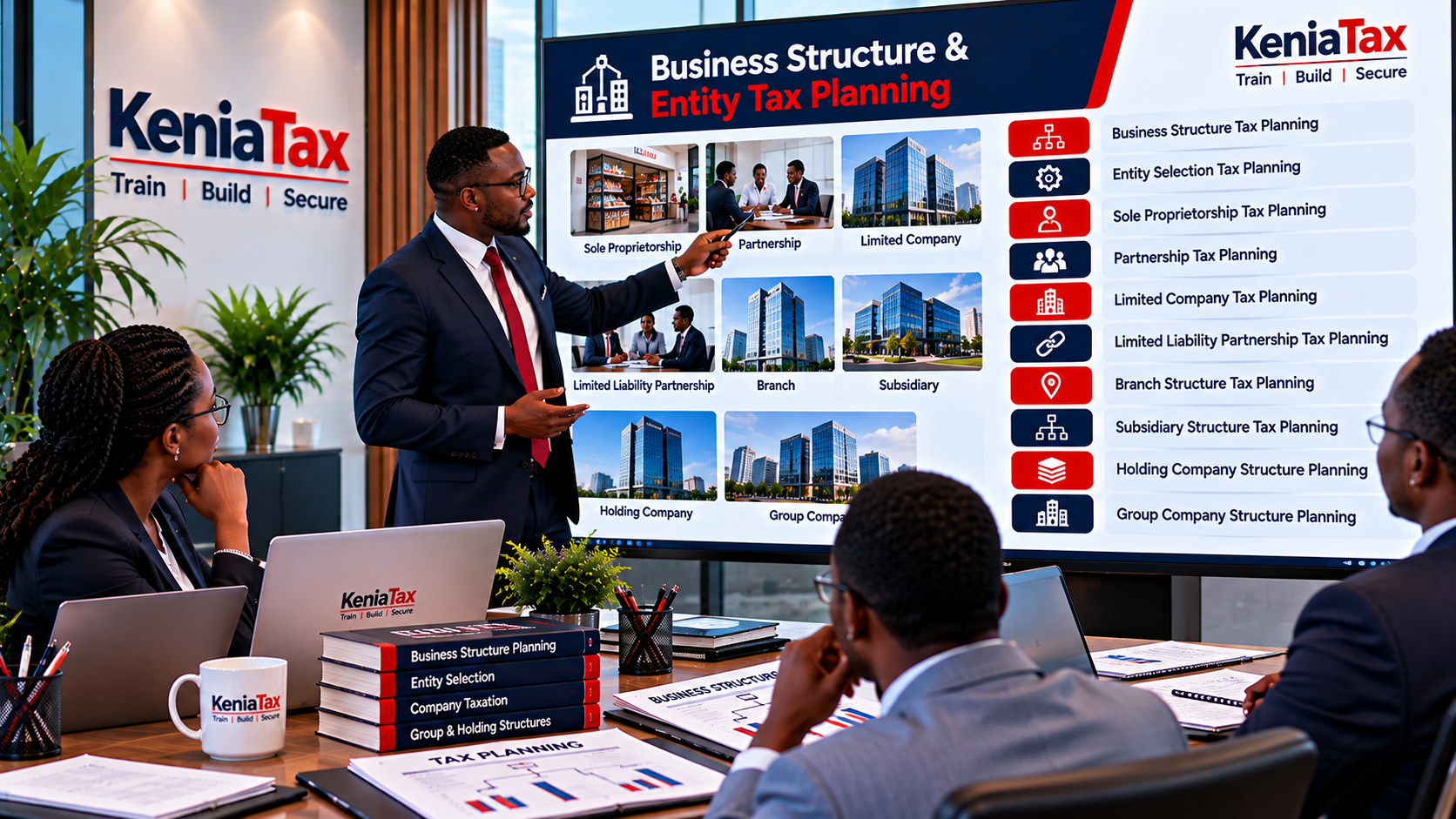
Business Structure & Entity Tax Planning
How a business is legally set up decides how it is taxed. Sole proprietors are taxed on profit at personal rates of up to 35%, partners on their share of the profits, and companies at 30% on profit, with withholding tax on dividends paid to owners. Groups also face choices about subsidiaries, branches, holding companies and special economic zones. There is no single best structure. The right one depends on profits, growth plans and how the owners take money out of the business.
In practice: A consultant earning KES 12 million in profit operates as a sole proprietor, so most of his profit is taxed at 35%. He plans to reinvest heavily to grow the firm. As a company, his profit would be taxed at 30%, leaving more money to reinvest. But if he intends to withdraw everything as dividends, the combined corporate and dividend tax could cost him more than staying a sole proprietor. In this programme, participants learn how each entity is taxed, how to compare structures for their own situation, how to plan salary and dividends, and how to manage the tax costs of changing structure as the business grows.
Income Tax Planning
Income tax is charged on what people and businesses earn, but the law provides deductions, reliefs and allowances that lawfully reduce taxable income. These include contributions to registered pension schemes, qualifying mortgage interest, housing levy and health contributions, business expenses, capital allowances and the timing of income and costs. Income tax planning means using every relief you are entitled to and supporting every claim with records.
In practice: Two managers each earn KES 300,000 a month. The first takes it all as salary. The second arranges for KES 30,000 a month to go into a registered pension scheme, within the legal limit. Because the contribution is deductible, the second manager’s taxable income falls by KES 360,000 a year, saving roughly KES 108,000 in tax at around 30%, money that now builds retirement savings instead of going to KRA. In this programme, participants learn which reliefs and deductions apply to employees, business owners, landlords and investors, how timing affects tax, and where lawful planning ends and risky avoidance begins.
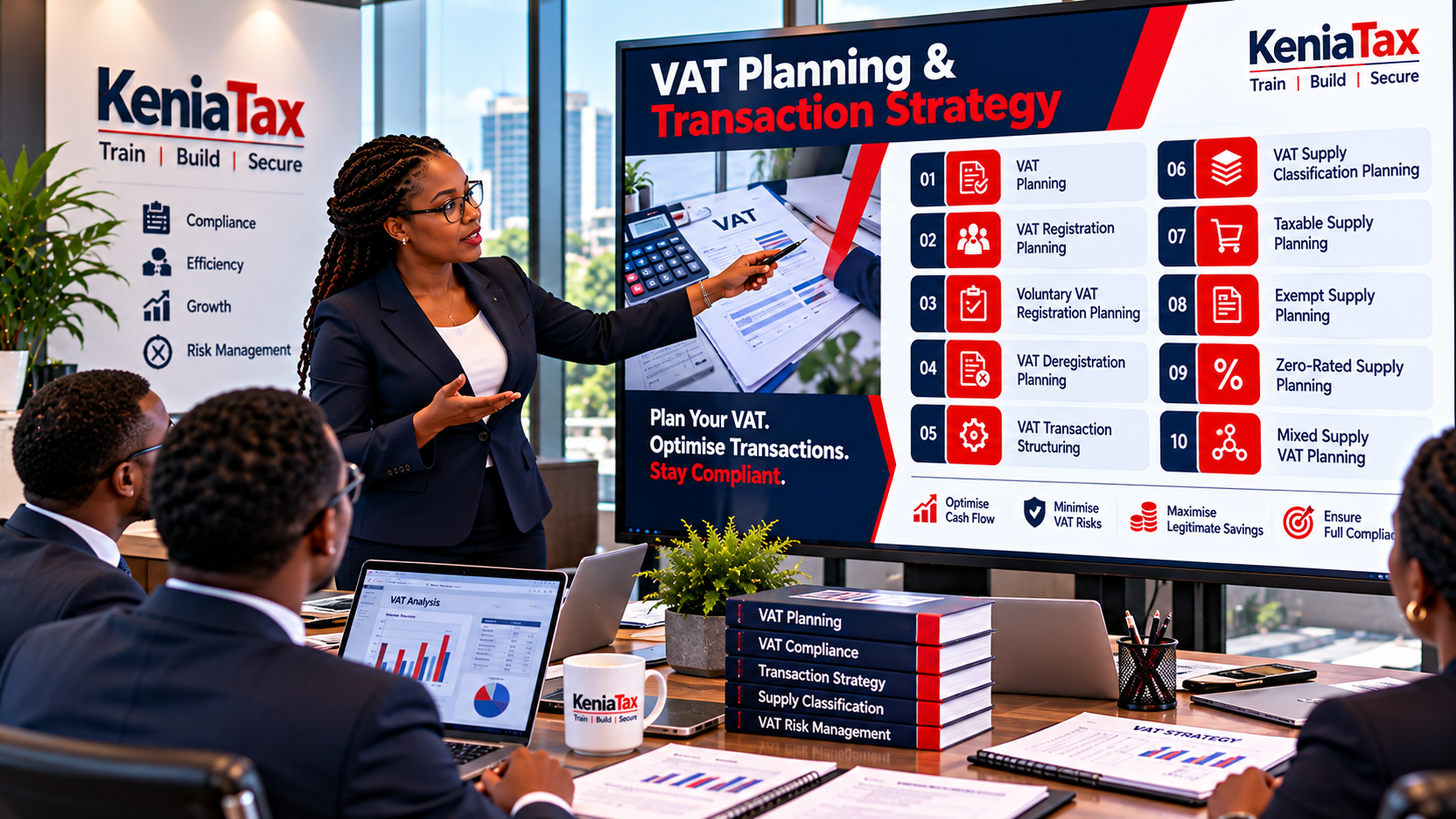
VAT Planning & Transaction Strategy
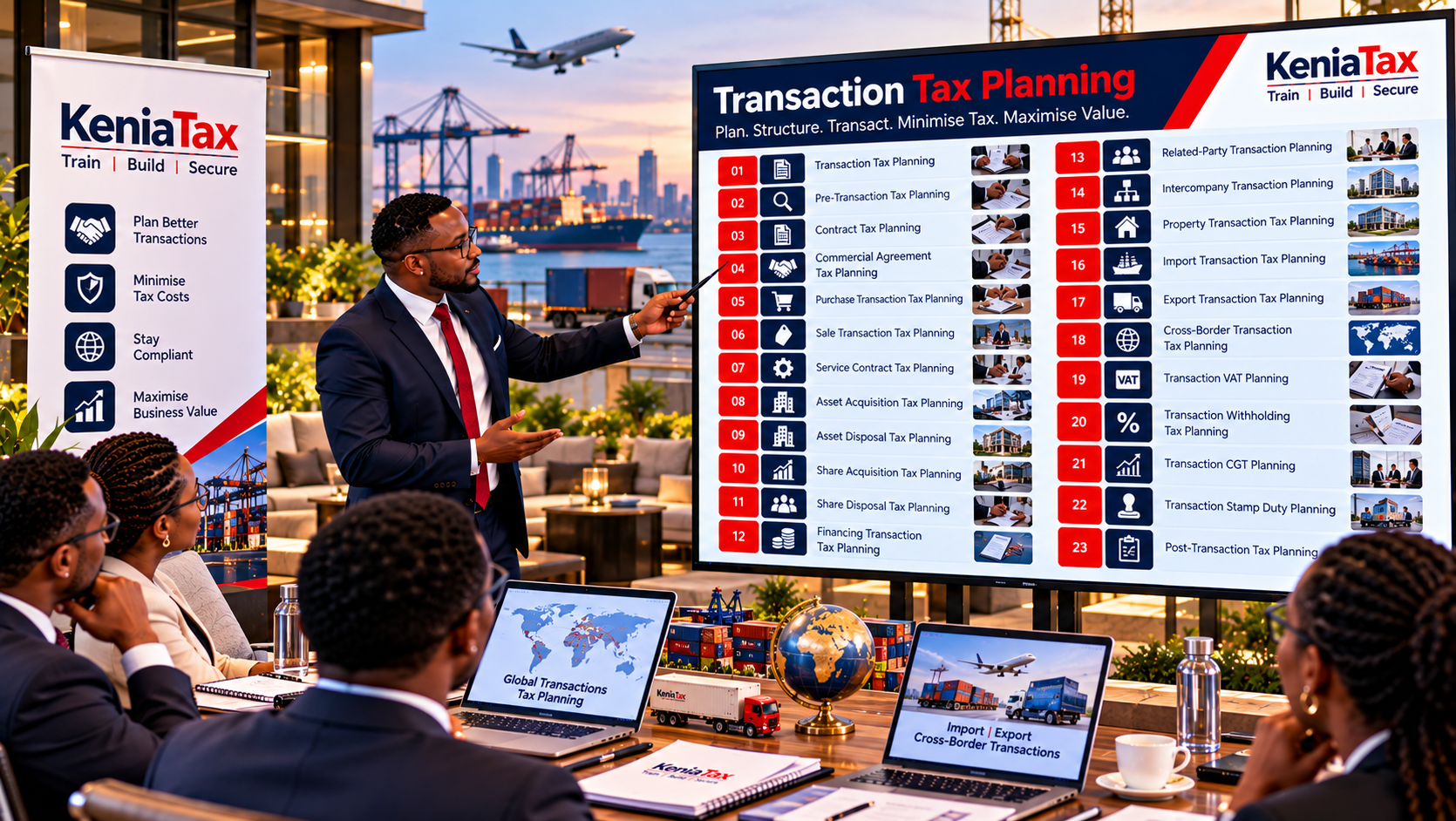
VAT touches almost every transaction, so how a deal is priced, structured, documented and timed changes how much VAT is paid, who bears it and when cash leaves the business. VAT planning means asking the right questions before a transaction: whether the supply is taxable, zero-rated or exempt, when VAT becomes due, whether input VAT can be recovered, and whether the price includes VAT.
In practice: A construction contractor agrees to build an office for KES 10 million but the contract does not say whether VAT is included. KRA treats the price as including VAT, so about KES 1.38 million belongs to KRA and the contractor earns only around KES 8.62 million. Had the contract said “KES 10 million exclusive of VAT”, the contractor would have invoiced KES 11.6 million and kept the full KES 10 million. In this programme, participants learn to draft and price contracts correctly for VAT, distinguish taxable, zero-rated and exempt supplies, apportion input VAT, manage VAT on imports and imported services, and plan for withholding VAT and refunds.
PAYE & Employee Tax Planning
How a business pays its people has a major effect on tax for both the business and its staff. Salaries, bonuses, allowances, per diems, meals, housing, cars, staff loans, pensions and share schemes are each taxed differently. Some are fully taxable, some are tax-free within limits, and some are deductible. PAYE and employee tax planning means designing pay and benefits so employees receive the most value from every shilling the business spends, while the business stays fully compliant.
In practice: A distribution company pays each of its 100 sales representatives a flat KES 15,000 monthly travel allowance and treats it as tax-free. KRA finds no records linking the payments to real travel and taxes them as salary, about KES 5.4 million in PAYE a year plus penalties. With planning, the company replaces the flat allowance with documented reimbursements and per diems for actual business travel within the tax-free limits. Staff receive the same support and the payments are lawfully tax-free. In this programme, participants learn to structure tax-efficient packages, apply the rules on allowances and benefits, use pension and deductible contributions, and handle bonuses, terminal benefits and expatriate pay.
Withholding Tax Planning
Withholding tax affects both what a business pays and what it receives. When paying suppliers, it must withhold the right tax at the right rate. When clients pay it, they may withhold tax that becomes a credit against its own income tax. Withholding tax planning means classifying payments correctly, using treaty rates where they apply, building withholding into pricing and contracts, and making sure every credit is recovered so cash is not left sitting with KRA.
In practice: An engineering consultancy earns KES 50 million a year, and its clients withhold 5% on every payment, a total of KES 2.5 million. After its costs, the firm’s actual income tax is only KES 1.5 million, so it overpays by KES 1 million every year. The excess credits pile up, and the firm borrows to cover the cash gap. In this programme, participants learn to classify payments correctly, apply domestic and treaty rates, structure contracts and payment terms with withholding in mind, track and offset credits and apply for refunds on time, so the firm keeps its working capital in the business.
Capital Gains Tax & Asset Disposal Planning
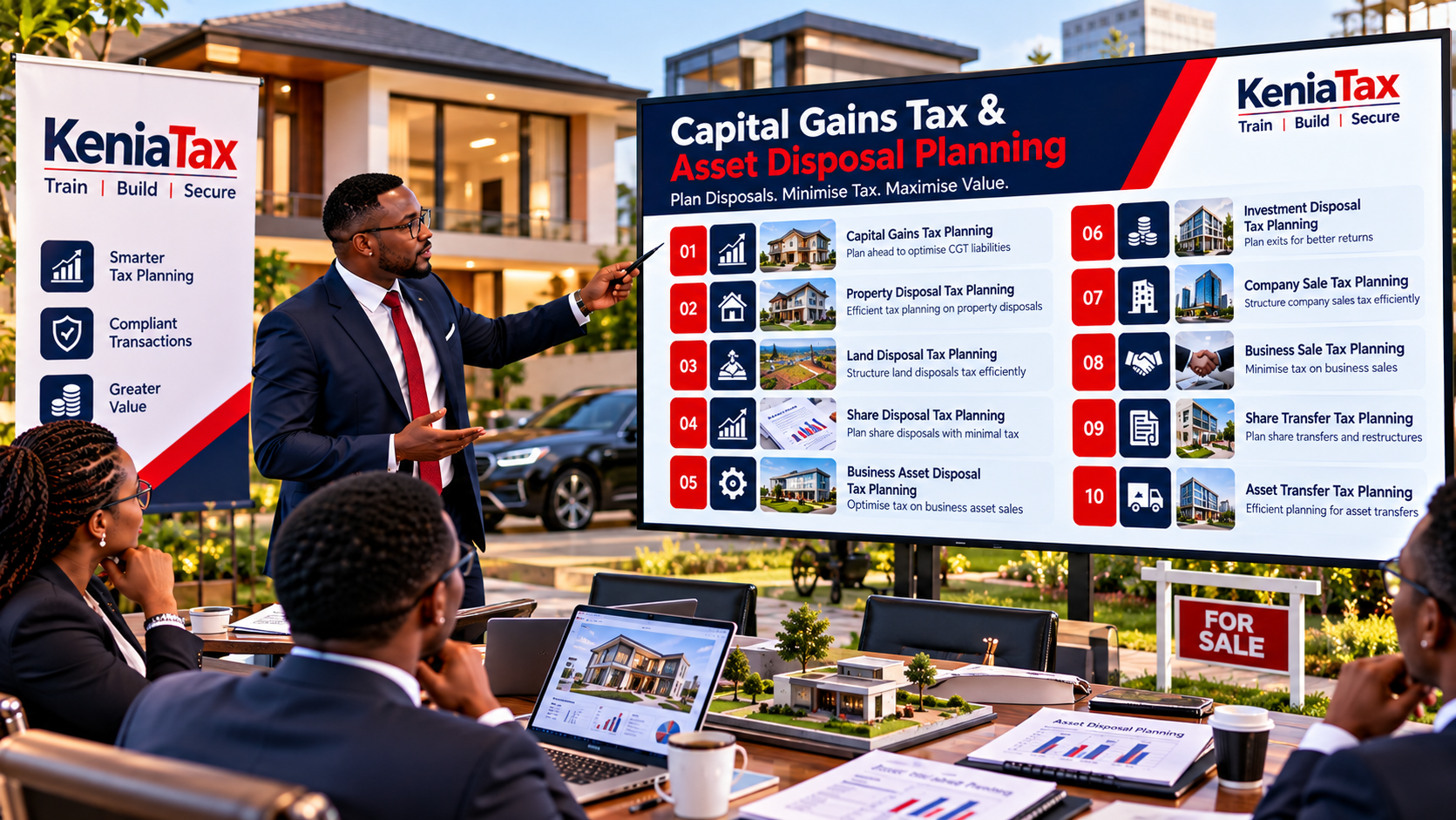
When land, buildings or shares in a private company are sold or transferred, capital gains tax is charged at 15% of the gain. But the tax depends on how the gain is calculated, which costs are included, whether exemptions apply, and how and when the sale is structured. Asset disposal planning means preparing before a sale so the business pays only what the law requires and the transaction closes without surprises.
In practice: A logistics company bought a warehouse in 2012 for KES 20 million and later spent KES 8 million on an extension. It now sells the warehouse for KES 50 million. With records of the extension, the gain is KES 22 million and the tax is KES 3.3 million. Without them, the company can only prove the original purchase price, the gain becomes KES 30 million and the tax rises to KES 4.5 million, KES 1.2 million lost for lack of receipts. In this programme, participants learn to build and preserve cost records, identify exemptions, compare asset sales with share sales, and coordinate capital gains tax, stamp duty and VAT on major disposals.
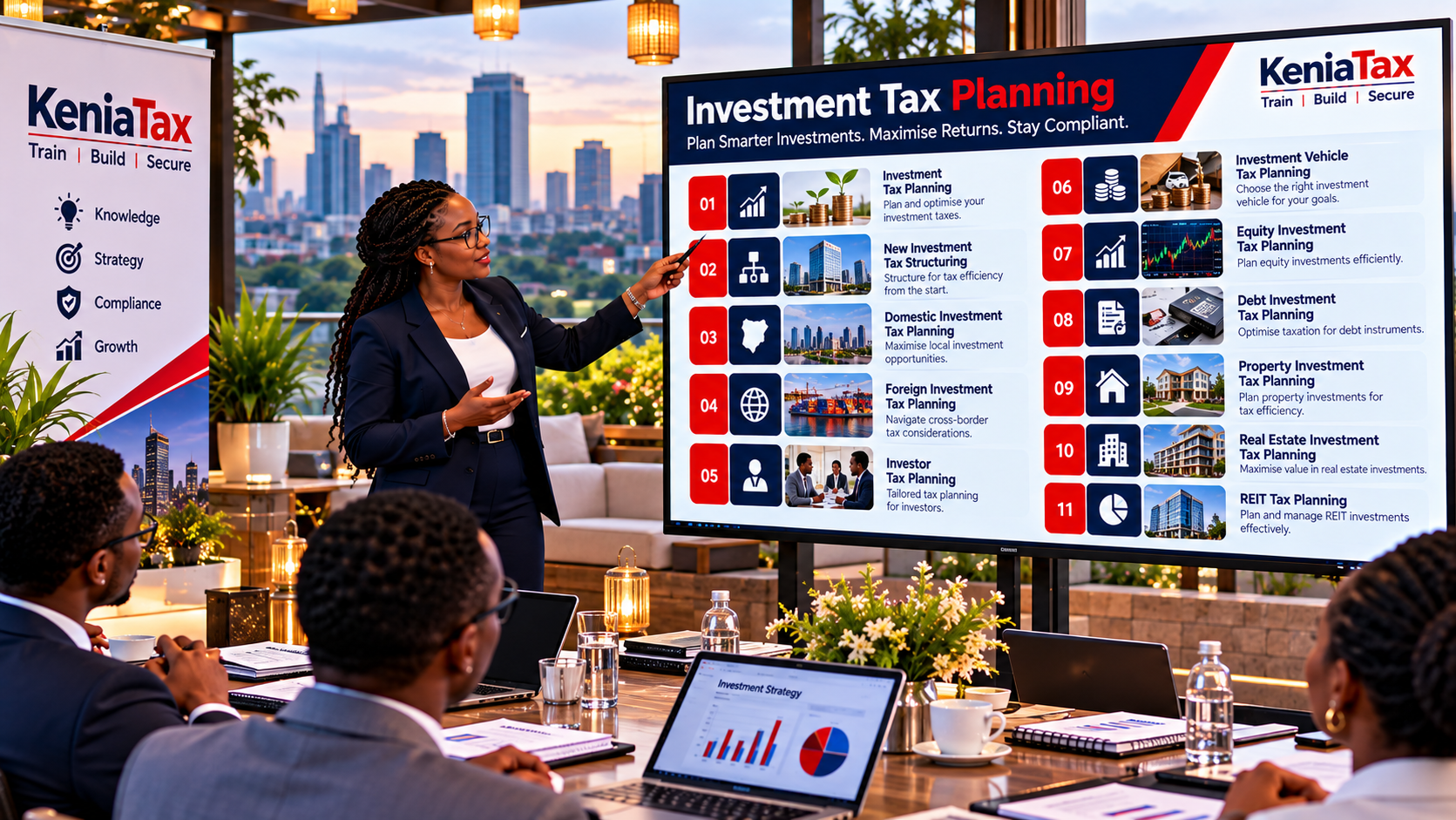
Investment Tax Planning
Every investment is taxed differently. Interest from deposits and most savings products has tax withheld at source, interest on government infrastructure bonds is exempt, listed shares are exempt from capital gains tax when sold, pension contributions are deductible, and business investment in plant and buildings brings allowances and incentives. Investment tax planning means comparing investments on their after-tax return, not just their headline rate.
In practice: Two business owners each invest KES 5 million at 10% a year. The first chooses a fixed deposit, earns KES 500,000 and has 15% withheld, keeping KES 425,000. The second chooses a government infrastructure bond at the same rate, and because the interest is tax-exempt, keeps the full KES 500,000. Same money, same rate, KES 75,000 a year difference. In this programme, participants learn to compare the after-tax returns of bonds, deposits, funds, shares, REITs and property, use tax-exempt and deductible options, plan pension savings, and manage tax on dividends and gains.
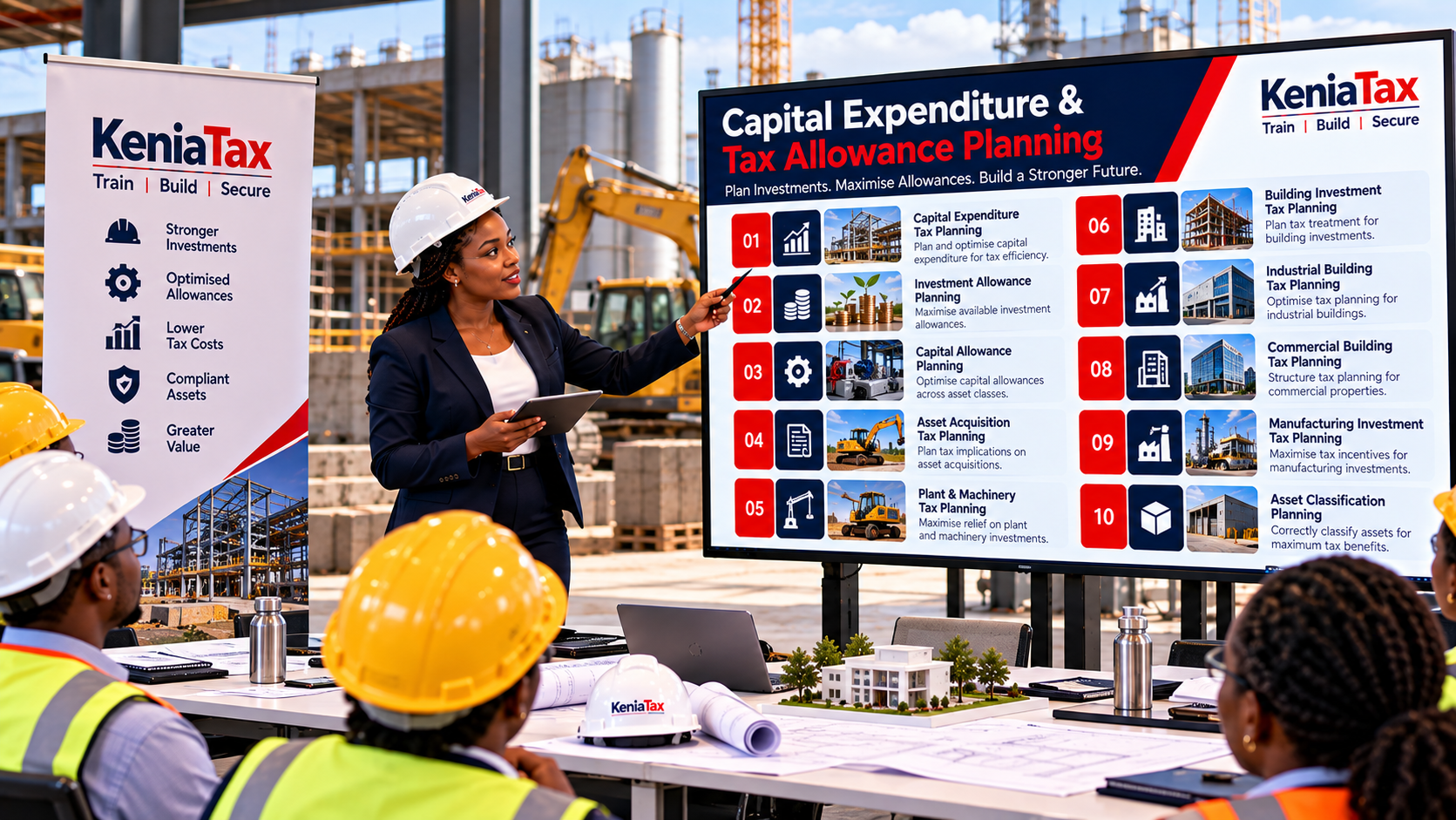
Capital Expenditure & Tax Allowance Planning
When a business buys long-term assets such as machinery, vehicles, computers, buildings or equipment, the cost is not deducted in one go like ordinary expenses. Instead, the law provides capital allowances and, for qualifying investments, investment deductions that spread or accelerate the tax relief. How an asset is classified, when it is bought and brought into use, where it is located and whether the spending is a repair or an improvement all affect how much relief is available and when. Capital expenditure and tax allowance planning means timing and structuring investment so the business receives the maximum relief at the right time.
In practice: A food processor plans to buy KES 50 million worth of new processing equipment. If the equipment is bought and brought into use before its financial year ends, it can start claiming allowances in that year. If delivery slips into the next month, the relief is pushed back a full year. If the first year’s allowances are worth KES 10 million, getting the timing right saves the company KES 3 million in tax this year, cash it can use to run the new line. In this programme, participants learn how capital allowances and investment deductions work, how to classify assets correctly, how to distinguish repairs from improvements, how to keep a tax-ready fixed asset register, and how to plan the timing and location of major investments.
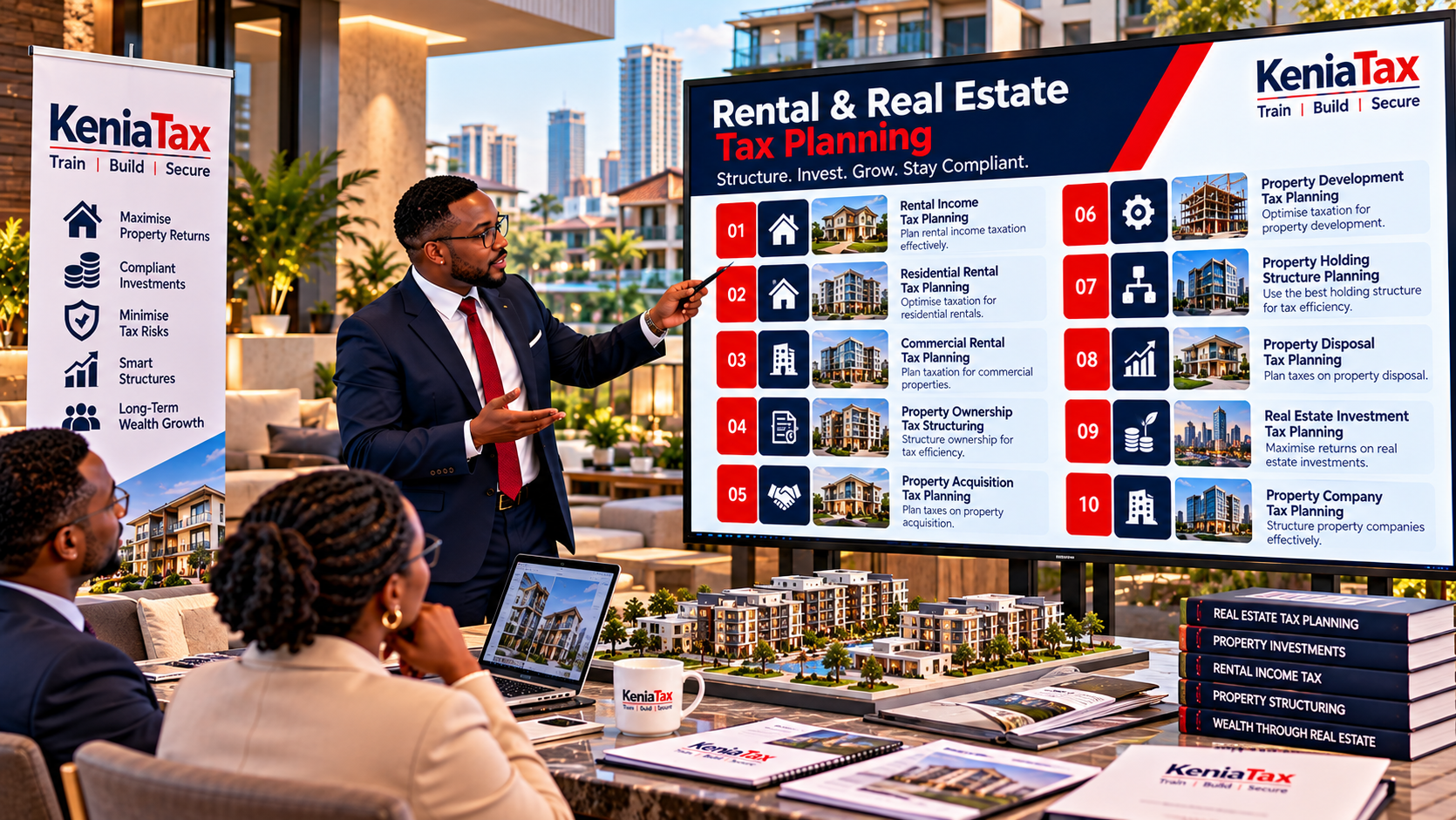
Rental & Real Estate Tax Planning
Property is taxed at every stage: stamp duty when bought, VAT on construction and commercial rent, income tax on rent, withholding tax by certain tenants, and capital gains tax and stamp duty again when sold. Residential landlords within the monthly rental income bracket pay 7.5% on gross rent, while commercial landlords are taxed on net profit after deducting genuine costs. Ownership structure, financing and records all affect what a property owner keeps.
In practice: A company owns a commercial building earning KES 12 million in rent a year. It genuinely spends KES 3 million on repairs, management, insurance and loan interest, but keeps receipts for only KES 1 million. It declares KES 11 million in taxable rent instead of KES 9 million and pays KES 600,000 more tax every year, KES 6 million over a decade. In this programme, participants learn to choose tax-efficient ownership structures, apply the right rental regime, claim every deduction and allowance, manage VAT on commercial property and construction, and plan acquisitions, transfers and sales.